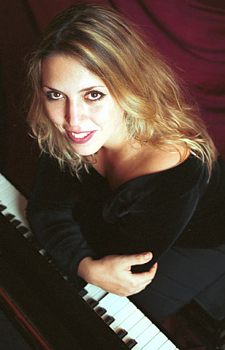
"When improvising," Gabriela says, "I connect to my audience in a completely unique way - and they connect with me. Because improvisation is such a huge part of who I am, it is the most natural and spontaneous way I can express myself. I have been improvising since my hands first touched the keyboard, but for many years I kept this aspect of my playing secret. Then Martha Argerich overheard me improvising one day and was ecstatic. In fact, it was Martha who persuaded me that it was possible to combine my career as a serious 'classical' artist with the side of me that is rather unique."
Ingrid Haebler was born in Vienna (Austria) on June 20, 1929. She studied at the Salzburg Mozarteum, Vienna Music Academy, Geneva Conservatory (Nikita Magaloff) and privately in Paris with Marguerite Long. She toured worldwide, but is best known for a series of recordings from the 1950s to 1980s. Her complete recording of Mozart's piano sonatas for the Denon label are still regarded as among the finest sets. Haebler also recorded all of Mozart's piano concertos (almost all of them twice) - often with her own cadenzas - and all of Schubert's sonatas. She was one of several Austrian musicians to experiment early with period instruments, having recorded music of J. C. Bach on a fortepiano. Her recordings of Beethoven with violinist Henryk Szeryng are particularly prized.
Today is Maxim Schostakovich's 72nd birthday. 10th of May 1957 was also the day, when the latter earned his Moscow Conservatory diploma by performing the premiére of father's (Dmitri Schostakovich's) 2nd Piano Concerto - dedicated to his son.
Dmitri Schostakovich on his 2nd piano concerto: "...I compose badly. Have just finished a piano concerto of absolutely no artistic or idealistic value."
Well, I don't know if I can agree on that strong self-critisism. It is true that the Second Piano Concerto is simpler then then other concertos, it's true that it is not calling for typical Schostakovich's sarcasm and satire (though there are very evident conflict points, as well as lots of humour in 1st and last movement). It's true that it is written in neoclasical style, in conventional thre-movement sonata form of an Allegro followed by romanticly inspired and melancholic middle movement closing with a joyful last movement. However, inspite of all this we must not overlook the fact, that its classical language is developed to the highest level (in derivation of motives, skilful use of poliphony, creation of characters and coulours, in building an unique musical thoughts and unit) and that in the same time it represents marvellous pedagogic tool - why it is accessible to many young people.
Madalena Soveral; one of the world's leading pianists specialized in the field of contemporary music
Madalena Soveral was born in Porto, where she studied music. She continued her training at the Porto Conservatory of Music, an then, sponsored by a grant from the SEC, at the Ecole Normale de Musique de Paris, where she obtained the “Licence de concert”. First studing under mother guidance, Hélia Soveral, she also studied under Reine Gianoli, Marian Rybicki, and Claude Helffer. In 1966 she awarded the “900 Musicale Europeo” prize, in Naples (Italy).
Madalena Soveral has given concerts since 1990, both solo and with orchestra, as well as various forms of chamber music festivals of Naples, Santiago de Compostela, Sceaux, Festival de Montpellier-Radio France, Mantova (Italy), The UNESCO Twentieth Century Music Festival (Paris), Música Nova (Brasil), The 1st Lisbon Festival of Contemporary Musics (Lisbonne, T.N.S.C.), as well as at the Academia de Santa Cecília (Roma), The Theatre du Rond-Point, Auditorium des Halles and The Theatro Municipal do Rio de Janeiro. During her career, Madalena Soveral has focussed on a 20th century repertoire working with a variety of composers and performers. Of special importance in this field is her work with the composer Giacinto Scelsi and with the “Les Percussions de Strasbourg” group, as well as her collaboration with the pianist Jean-Louis Haguenauer and the percussionists Christian Hamouy and Georges Van Gucht. Madalena Soveral has performed the world premiere of numerous pieces, including those written especially for her : Estudos de Sonoridades (Filipe Pires), Interrogations (Miguel Graça Moura), Dominos (Sharon Kanach), In Tempore, for piano and electronic (João Pedro Oliveira), and Episode, for two pianos and two percussions (Francis Bayer).
Today, Madalena Soveral works as a Professor (and Coordinator) at the Escola Superior de Música e das Artes do Espectáculo do Porto. Besides that she is working on a research project on 20th Century Portuguese Piano Music, at the University of Paris 8. Étude Analytique des Litanies du feu et de la mer d’Emmanuel Nunes, carried out between 1997-99, constitued the first part of that work. In 2005 she completed the Doctorat in Music with the teses Quatre compositeurs, Quatre oeuvres: la musique portugaise pour piano des années 90, about the piano’s compositions from António Pinho Vargas, Filipe Pires, João Pedro Oliveira, and João Rafael. In 2006 Madalena Soveral joined the research Center CESEM (Centro de Estudos de Sociologia e Estética Musical) of the Universidade Nova de Lisboa.
The artist has issued several CDs, among which is particularly reboant a CD with the complete Schönberg's piano-solo works:
Petar Milić was born in Kranj, where he began his piano lessons with prof. Sabira Hajdarević. He continued his musical education in Secondary Music School in Ljubljana in the class of yearlong and wonderful Professor Janez Lovše, who remained his mentor also in the Academy of Music. Already during the study, he has given many concerts in Slovenia, recorded for RTV Slovenia and worked with renowned international masters such as Arbo Valdma, Igor Lazko, Daniel Alberto, Pascal Devoyon and Elena Lapitskaja. In 1977, he attended an international piano competition "Nikolai Rubinstein" in Paris where he won first prize and was invited to a festival in Geneva "Recontres Musicales de Geneve." His musical career continued with postgraduate studies at the Hochschule der Künste in Berlin with Professor Klaus Hellwig. During this time he performed in Berlin, Hanover, as well as in Slovenia, where he made several audio and video clips for RTV Slovenia. In the context of international tribune of young musicians, an idea that was initiated by Yehudi Menuhin, in 2001, the jury of European radio outlets selected a clip of his recital, what gave him oppurtunity to participate at the music festival in Bratislava. His live solo performance was accompanied by several million listeners in Europe. As a solist, Petar Milić performed with chamber orchestra Carnium, Slovenian RTV Symphony Orchestra and Orchestra of Slovenian Philharmony. He participated as well in many international festivals such as Carniola, Cellomusica, Bohinj and Piran Summer Festival...
If there were no legendary recordings, we know so little about Youra Guller's life, we could almost think she did not exist at all.
French pianist of Russian-Romanian origin began her music career with the age of five. At the age of nine, she enrolled at the Paris Conservatory, where she studied under the mentorship of Isidor Pilipp. During the study years, she met composer Milhaud (and other members of "Les Six") and regularly performed his works. After having graduated, she performed in many tours, with an emphasis on Chopin's music. In 1941 she had run from Paris to Marseilles (because of the war). There she met Clara Haskil. Even more than that. The facts say that she was responsible for helping Clara Haskil escape out of Nazi clutches (though she was of Jewish descent herself and therefor in grave danger). In the post-war period Youra Guller suffered from ilness, that is the reson she moved away for eight years. Sources say (though we don't know for sure) that she had been living somewhere in Shanghai or in Bali. In 1955, she appeared in London, from where she began to return to the stage boards. The year 1971 is known for her debut in New York's Carnegie Hall. In 1975 she made important and one of the few recordings for the Nimbus label.
Such as the rest of her life - elusive and wrapped in fog, the end was like that aswell. Youra Guller ended her journey (one can not know precisely) in 1980 or 1981, possibly in Geneva, Paris or London.